
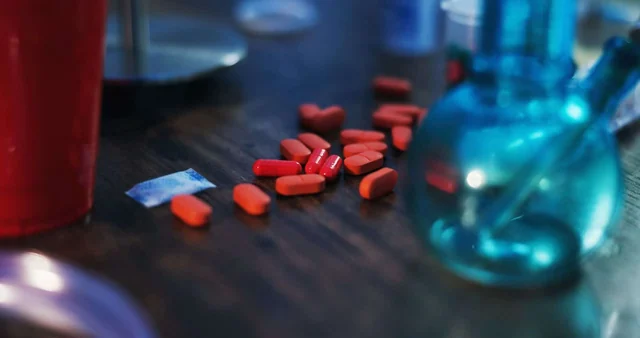
HS 11364 is a misdemeanor, never a felony. It makes it unlawful to possess a pipe or other device used to inject or smoke listed drugs such as heroin, fentanyl, cocaine, or methamphetamine. Because the statute sets no penalty, Health and Safety Code section 11374 applies: a $30 to $500 fine, 15 to 180 days in jail, or both. It is a separate charge from possessing the drug.
What HS 11364(a) prohibits
Health and Safety Code section 11364(a) makes it unlawful to possess "an opium pipe or any device, contrivance, instrument, or paraphernalia used for unlawfully injecting or smoking" certain controlled substances. The statute lists them by schedule rather than by name. The list reaches the opiates and opium derivatives in section 11054(b) and (c), such as heroin; depressants such as GHB and methaqualone under 11054(e); cocaine base under 11054(f)(1); mescaline, peyote, and synthetic tetrahydrocannabinols under 11054(d)(14), (15), and (20); the substances in section 11055(b) and (c), which include cocaine and fentanyl; methamphetamine under 11055(d)(2); and any narcotic drug in Schedules III, IV, or V.
The standard jury instruction, CALCRIM No. 2410, breaks the offense into three elements:
- The defendant possessed an object used for unlawfully injecting or smoking one of the listed controlled substances.
- The defendant knew of the object's presence.
- The defendant knew it to be an object used for unlawfully injecting or smoking a controlled substance.
Possession does not require holding the item. The instruction says it is enough to have control over it, or the right to control it, personally or through another person, and that two or more people can possess something at the same time. That is how a pipe found in a shared car or a room becomes a charge against more than one person, and why who controlled the space is often the first factual question.
Is HS 11364 a felony or a misdemeanor?
It is a misdemeanor. Section 11364 does not state a penalty of its own, and Health and Safety Code section 11374 covers every violation in this division of the code that has no specific penalty: a misdemeanor punishable by a fine of "not less than thirty dollars ($30) nor more than five hundred dollars ($500), or by imprisonment for not less than 15 nor more than 180 days, or by both." It is not a wobbler, so it cannot be charged as a felony. It also does not appear on the list in Penal Code section 19.8 of misdemeanors that may be treated as infractions.
The felony exposure sits in a different statute. Under section 11364.7(a), delivering, furnishing, or transferring drug paraphernalia, or possessing it with intent to do so, knowing or when one reasonably should know that it will be used with a controlled substance, is a separate misdemeanor. Subdivision (b) makes manufacturing paraphernalia for distribution, knowing it will be used with cocaine, cocaine base, heroin, PCP, or methamphetamine, punishable by up to a year in county jail or by state prison. Subdivision (c) raises the penalty to up to a year in county jail, a fine of up to $1,000, or both for an adult who furnishes paraphernalia to a minor at least three years younger. A business that keeps or sells paraphernalia is regulated separately under section 11364.5.
Is 11364 a separate charge from drug possession?
Yes. Possessing the drug itself is charged under other statutes, typically section 11350 or section 11377, and those offenses have their own elements, including proof of a usable amount. A paraphernalia count has no usable-amount requirement, so it can stand even when a residue-based possession count cannot, as explained in whether drug residue in a pipe can support a charge. The reverse is also true: the paraphernalia count requires proof that the person knew the object was used for injecting or smoking drugs, which a possession count does not. For the drug charge itself, see the firm's page on hard drug possession.
The way the count is written matters too. When one count alleges several items, such as two different pipes, the CALCRIM No. 2410 bench notes say the court must instruct jurors that they all have to agree on at least one particular item the defendant possessed.
What HS 11364 does not cover
- Syringes for personal use. Section 11364(d) states the law "shall not apply to the possession solely for personal use of hypodermic needles or syringes," and subdivision (b) excludes needles and syringes containerized for safe disposal in a container that meets state and federal standards for sharps waste. Exchange programs and pharmacy purchases are covered in syringe possession and needle exchange laws.
- Drug checking. Subdivision (c) says the section does not apply to someone obtaining controlled substance checking services, and testing equipment such as fentanyl test strips is excluded from the definition of drug paraphernalia in section 11014.5(d). See whether fentanyl test strips are legal.
- Cannabis devices. Cannabis is listed in section 11054(d)(13), a paragraph section 11364 does not name; the named paragraph (d)(20) covers synthetic tetrahydrocannabinols, not the plant. The CALCRIM No. 2410 notes, citing In re Johnny O. (2003) 107 Cal.App.4th 888, state that possessing a device for smoking cannabis, without more, is not a crime, and section 11362.1(a)(5) allows adults 21 and older to possess cannabis accessories.
Diversion, dismissal, and record consequences
Section 11364 is one of the offenses listed in Penal Code section 1000(a) for pretrial drug diversion. Eligibility depends on conditions in that subdivision: no conviction within five years for a drug offense other than the listed ones, no violence or threatened violence in the charged offense, no evidence of a separate contemporaneous drug violation outside the listed offenses, and no felony conviction within five years. Diversion lasts 12 to 18 months under section 1000.2(c), and if it is completed, section 1000.3(d) requires dismissal. Under section 1000.4(a), the arrest is then deemed never to have occurred, with exceptions, although subdivision (b) lets listed licensing agencies request diversion records. The firm's PC 1000 drug diversion page explains the process.
Noncitizens should look at the immigration side before any plea. In Mellouli v. Lynch (2015), a case about a state paraphernalia conviction, the U.S. Supreme Court held that to deport someone on the controlled substance ground, the government must connect an element of the conviction to a drug defined in the federal Controlled Substances Act. How that rule applies to a particular California record is a question to resolve before the case is resolved.
For how the firm handles these cases, see its drug paraphernalia defense page.