
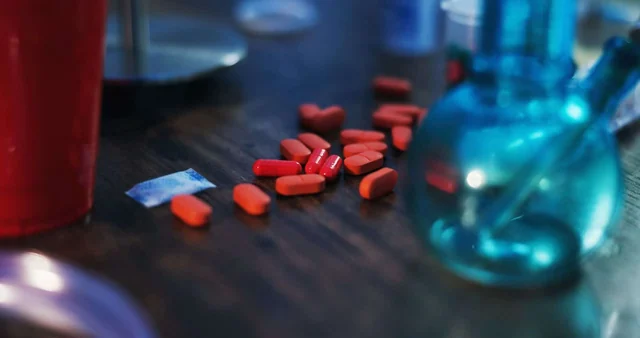
Yes. Health and Safety Code 11377(a) makes it a crime to possess amphetamine, the Schedule II drug in Adderall, unless a California-licensed physician, dentist, podiatrist or veterinarian prescribed it. The base penalty is up to 364 days in county jail, a misdemeanor. Federal law has its own possession offense.
Is Adderall a controlled substance?
Yes. Adderall contains amphetamine, which California lists in Schedule II in Health and Safety Code 11055(d)(1) and federal regulation lists in Schedule II too.
The drug label that the National Library of Medicine publishes on DailyMed says Adderall "contains amphetamine, a Schedule II controlled substance."
Section 11055(a) says "The controlled substances listed in this section are included in Schedule II." Subdivision (d)(1) lists "Amphetamine, its salts, optical isomers, and salts of its optical isomers." The schedule lists the substance, not the brand name Adderall.
As of November 21, 2026, 21 CFR 1308.12(d)(1) lists the same substance, "Amphetamine, its salts, optical isomers, and salts of its optical isomers", in federal Schedule II.
Is Adderall a narcotic?
No, not under California's definition. Section 11019 lists opium and opiate, poppy, coca, cocaine, ecgonine and acetylfentanyl substances. Amphetamine is not on that list.
Section 11019 defines a narcotic drug by a list. It names opium and opiate products, opium poppy and poppy straw, coca leaves, cocaine, ecgonine, and acetylfentanyl with its listed derivatives. Amphetamine does not appear in it.
The label matters because the main possession sections divide drugs by schedule and type. Section 11350(a) covers a controlled substance "specified in subdivision (b) or (c) of Section 11055" and a Schedule III, IV or V substance "which is a narcotic drug". Amphetamine is in subdivision (d) of Section 11055, and Section 11377(a)(5) covers substances "specified in subdivision (d), (e), or (f) of Section 11055".
Federal law defines the term separately. 21 U.S.C. 802(17) lists opium and opiates, poppy straw, coca leaves, cocaine and ecgonine, and any compound, mixture or preparation containing them. Amphetamine is not in that list either.
Which California law covers having Adderall without a prescription?
Section 11377(a) punishes possessing a substance listed in Section 11055(d) unless a physician, dentist, podiatrist or veterinarian licensed in California prescribed it.
Section 11377(a) reaches "every person who possesses any controlled substance which is" in listed groups, including one "specified in subdivision (d), (e), or (f) of Section 11055". The exception comes next: the possession is punished "unless upon the prescription of a physician, dentist, podiatrist, or veterinarian, licensed to practice in this state". The section sets a county jail term of "not more than one year", and Penal Code 18.5(a) makes that "a period not to exceed 364 days."
Penal Code 17(a) says "Every other crime or public offense is a misdemeanor except those offenses that are classified as infractions." A crime whose only punishment is county jail for up to 364 days is therefore a misdemeanor. Subdivision (b) of Section 11377 lets the judge "assess a fine not to exceed seventy dollars ($70)".
Section 11377(a) also has a felony route for a person with a listed prior: a conviction for an offense named in Penal Code 667(e)(2)(C)(iv), or for an offense that requires registration under Penal Code 290(c). That person "may instead be punished pursuant to subdivision (h) of Section 1170 of the Penal Code". Under Penal Code 17(a), a crime punishable that way is a felony. Because the section says "may" instead of "shall", the sentence is up to the court.
The firm's page on unlawful possession or sale of prescription drugs covers these charges, and its answer on carrying prescription medicine without its bottle covers loose pills and containers.
What if the Adderall was prescribed to someone else?
Section 11377(c) says someone else may hold the medication at the holder's direction or express authorization, solely to deliver it to the holder or discard it lawfully.
Subdivision (c) says it "is not unlawful for a person other than the prescription holder to possess a controlled substance described in subdivision (a)" if two conditions are both met. The first is that the possession is "at the direction or with the express authorization of the prescription holder." The second is that the possessor's "sole intent" is "to deliver the prescription to the prescription holder for its prescribed use or to discard the substance in a lawful manner."
Subdivision (d) sets a limit. The section "does not permit the use of a controlled substance by a person other than the prescription holder or permit the distribution or sale of a controlled substance that is otherwise inconsistent with the prescription."
Selling or giving away Adderall is a different offense. Section 11379(a) covers a person who "sells, furnishes, administers, or gives away" a controlled substance in its listed groups, which include substances specified in Section 11055(d). It states a term "pursuant to subdivision (h) of Section 1170 of the Penal Code for a period of two, three, or four years."
How does federal law differ?
Federal law has its own possession offense, 21 U.S.C. 844(a), which turns on a valid prescription from a practitioner and states a different penalty.
21 U.S.C. 844(a) makes it unlawful to possess a controlled substance unless it "was obtained directly, or pursuant to a valid prescription or order, from a practitioner, while acting in the course of his professional practice". It adds an exception for possession "otherwise authorized by this subchapter or subchapter II". 21 U.S.C. 802(21) defines a practitioner as a physician, dentist, veterinarian, scientific investigator, pharmacy, hospital, or other person "licensed, registered, or otherwise permitted, by the United States or the jurisdiction in which he practices or does research". California's exception is worded differently. It names prescribers "licensed to practice in this state". This page does not say how that wording applies to a prescription written by a prescriber licensed in another state.
For the penalty, Section 844(a) states that a violator "may be sentenced to a term of imprisonment of not more than 1 year, and shall be fined a minimum of $1,000, or both". After a prior drug conviction has become final, it states a term "for not less than 15 days but not more than 2 years" and a minimum fine of $2,500.
| California | Federal | |
|---|---|---|
| Schedule II listing | Health and Safety Code 11055(d)(1) | 21 CFR 1308.12(d)(1) |
| Possession offense | Health and Safety Code 11377(a) | 21 U.S.C. 844(a) |
| Prescription exception | Prescription of a physician, dentist, podiatrist or veterinarian licensed to practice in California | Valid prescription or order from a practitioner acting in the course of professional practice |
| Base penalty the statute states | County jail for up to 364 days (Penal Code 18.5(a)); the judge may assess a fine of up to $70 | Imprisonment of not more than 1 year, a minimum fine of $1,000, or both; higher terms after a prior conviction |
California rules from Health and Safety Code 11377 and Penal Code 18.5; federal rules from 21 U.S.C. 844(a) and 21 CFR 1308.12.
Did Proposition 36 of 2024 change the penalty?
Proposition 36 added Section 11395, but its definition of a hard drug leaves out substances in Section 11055(d) other than methamphetamine, so it does not reach amphetamine.
Section 11395, added by Proposition 36 in 2024, is known as the "Treatment-Mandated Felony Act." It applies to "a person described in subdivision (c) who possesses a hard drug". Subdivision (c) describes a person with prior convictions for listed drug offenses. Subdivision (e)(1) says a hard drug "means a substance listed in Section 11054 or 11055", and subdivision (e)(2) leaves out, "with the exception of methamphetamine, any other substance listed in subdivision (d) of Section 11055."
Amphetamine is listed in Section 11055(d)(1). Methamphetamine is the separate entry in (d)(2), "Methamphetamine, its salts, isomers, and salts of its isomers." On those words, amphetamine is not a hard drug, and an Adderall possession charge falls under Section 11377(a), not Section 11395.
The prior convictions that bring a person within Section 11395 are listed in subdivision (c), and the list includes Section 11377. A conviction for possessing Adderall under Section 11377 can therefore count toward the "two or more prior convictions" if the person is later charged under Section 11395 with possessing a hard drug. The firm's page on Proposition 36 covers the 2000 and 2024 laws.
Related questions
- Can carrying prescription medicine without its bottle lead to a drug charge?
- Can I get PC 1000 drug diversion again if I already completed it once before?
- What counts as prescription fraud or doctor shopping in California?
Frequently asked questions
Can I be charged with DUI after taking Adderall as prescribed?
Yes. The offense is driving while under the influence of a drug, and being entitled to use the drug is not a defense. Vehicle Code 23152(f) says "It is unlawful for a person who is under the influence of any drug to drive a vehicle." Section 23630 says that being entitled to use the drug under state law "shall not constitute a defense". The firm's page on DUI and prescription drugs covers these charges.
Can an Adderall possession charge go to drug diversion?
Possibly. Penal Code 1000(a) names "Section 11377, or Section 11550 of the Health and Safety Code" among the offenses it covers, but it applies only if it "appears to the prosecuting attorney" that four conditions about the defendant's record and the offense are met. The firm's page on PC 1000 drug diversion covers the process.
Talk to a lawyer
The Law Offices of David S. Chesley defend drug charges across California (see the firm's drug charges lawyer page).
The firm offers a free consultation, is available 24/7, and offers payment plans. Se habla español. Call (800) 755-5174 or request a free consultation online.
This page is general information, not legal advice, and no outcome is guaranteed.