
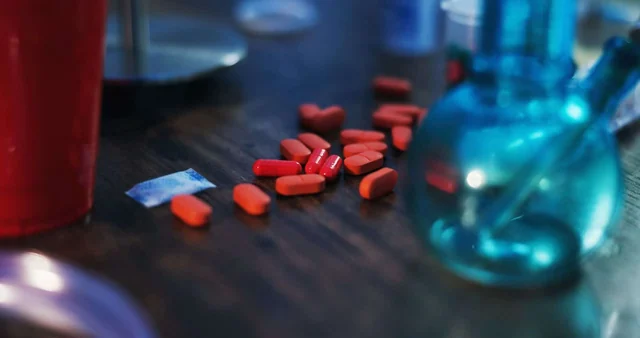
Not by itself. California’s drug possession laws ask whether you have a valid prescription for the drug, not what container it is in, and the pharmacy labeling law applies to the pharmacist, not to you. Officers who find loose pills may still question you, and may arrest you if they are not satisfied the pills are lawfully yours, so be ready to show that the prescription is real.
What the possession statutes say
Possession of many controlled substances, including most opioids, is charged under Health and Safety Code section 11350. Subdivision (a) makes possession unlawful “unless upon the written prescription of a physician, dentist, podiatrist, or veterinarian licensed to practice in this state.” Nothing in the section mentions a bottle, a label, or any other container. Many other prescription drugs, including stimulants such as amphetamine and methylphenidate (listed in section 11055(d)), fall under section 11377, which has a similar prescription exception and no container rule either.
The exception covers medication prescribed to you. Carrying someone else’s medication is lawful only in the narrow situation described below, and both sections say they do not permit anyone other than the prescription holder to use the drug (sections 11350(e) and 11377(d)).
The state Pharmacy Law says much the same thing. Business and Professions Code section 4060 bars possessing a controlled substance except one furnished on a prescription or drug order from an authorized prescriber. Its only container language is an exception for suppliers and practitioners, such as manufacturers, wholesalers, pharmacies, and listed prescribers, whose stock is kept “in containers correctly labeled with the name and address of the supplier or producer.” That clause is about inventory. It does not address a patient’s own dispensed medication.
Where the labeling rule applies
The labeling rule people usually have in mind is Business and Professions Code section 4076, and it binds the pharmacist. A pharmacist may not dispense a prescription except in a correctly labeled container showing, among other things, the drug, the directions, the patient’s and prescriber’s names, the pharmacy’s name and address, the strength, the quantity, and, for most outpatient prescriptions since 2006, a description of what the pill looks like. The duty applies when the pharmacist dispenses. Section 4076 says nothing about keeping the medication in that container afterward, and neither possession statute refers to it.
If you are carrying someone else’s medication
Sections 11350(d) and 11377(c) make it lawful for someone other than the prescription holder to possess the medication if both of these are true: the possession is at the direction or with the express authorization of the prescription holder, and the sole intent is to deliver it to the holder for its prescribed use or to discard it lawfully. Picking up a parent’s prescription and bringing it home is an example. The rule does not cover taking the medication yourself or passing it to anyone else.
If you are stopped with loose pills
Under CALCRIM No. 2304, the jury instruction for simple possession, you do not have to prove your prescription. When there is evidence of one, jurors are told that the prosecution must prove beyond a reasonable doubt that you did not have a valid prescription, and the instruction’s bench notes say the defendant need only raise a reasonable doubt. The instruction has no container element, and its notes add that the prescription defense does not apply to every controlled substance.
An officer deciding whether to arrest is not applying that trial standard, so it helps to be able to show right away:
- A pharmacy printout, refill history, or the pharmacy’s app showing the prescription in your name.
- The prescription number or the prescriber’s contact information.
- An insurance or payment record tied to the fill.
- If you are carrying the medication for someone else, a way to show whose prescription it is and why you have it.
None of this is a legal requirement. It gives you, and later your lawyer, something concrete to point to if the prescription is questioned. If your case involves more than a container question, such as a dispute over whether the pills were yours at all, the firm’s page on hard drug possession covers the knowledge and quantity defenses that can also apply.
Getting help
The prescription record and the circumstances of the stop are worth a closer look if you were detained, arrested, or charged after police found your medication outside its original container. Contact the Law Offices of David S. Chesley: the direct line is (800) 755-5174.