



A drug charges lawyer in Beverly Hills defends cases prosecuted by the Los Angeles County District Attorney, which files both misdemeanors and felonies from the city, and heard at the LA Airport Courthouse. The city's own police department makes local arrests. Simple possession is usually a misdemeanor; sales, transport and repeat cases can be felonies.
Our law firm has been featured on






David Chesley in the news
Select a photo to enlarge







Why does the District Attorney handle every drug charge from Beverly Hills?
Beverly Hills is not one of the ten Los Angeles County cities that prosecute their own misdemeanors, so the District Attorney files both misdemeanor and felony drug cases there.
Felonies from anywhere in the county go to the District Attorney, and its office FAQ names only ten cities whose misdemeanors it does not handle: Burbank, Hawthorne, Hermosa Beach, Inglewood, Long Beach, Los Angeles, Pasadena, Redondo Beach, Santa Monica and Torrance. Beverly Hills is not on that list. That has a practical effect. Inside the City of Los Angeles, the Los Angeles City Attorney prosecutes misdemeanors instead, so the same possession arrest can land with a different prosecutor depending on which side of the city line it happened. For Beverly Hills, the District Attorney's Airport Branch Office is at 11701 South La Cienega Boulevard, Suite 601, (310) 727-6500, the same address as the Airport Courthouse.
| Office | Its role | Contact |
|---|---|---|
| Beverly Hills Police Department | Arrest, search, booking at the city jail | 464 N. Rexford Drive, Beverly Hills, CA 90210; non-emergency (310) 550-4951 |
| Los Angeles County District Attorney | Files misdemeanor and felony drug charges | Airport Branch Office, Suite 601; (310) 727-6500 |
| LA Airport Courthouse | Arraignment, motions, trial and sentencing | 11701 S. La Cienega Boulevard, Los Angeles, CA 90045; (310) 725-3000 |
| Los Angeles County Public Defender | Defense for people who cannot afford a lawyer | Airport Courthouse, 5th floor, Room 530; (310) 727-6200 |
A lawyer who knows which office decides your case can start talking to the right people early. The firm's Los Angeles County drug crimes page lists the charges it defends, and the statewide drug charges lawyer page covers the same law across California.
Why is a Beverly Hills drug case heard at the Airport Courthouse?
Beverly Hills sits in the court's West District, and the Airport Courthouse is the only building in that district that hears criminal cases; the Beverly Hills Courthouse does not.
The court's Local Rules, Chapter 2, effective July 1, 2026, place three courthouses in the West District: Santa Monica, Beverly Hills and the LA Airport Courthouse. Rule 2.3(a)(3) sends each criminal complaint to the courthouse handling criminal matters for the city where the offense allegedly happened. The court's own courthouse data shows the Beverly Hills Courthouse on Burton Way serving civil, small claims and traffic matters, while the Airport Courthouse serves criminal cases only.
Your citation or release papers name the court and the date, and they control; the rule also lets the criminal division's supervising judge order a filing elsewhere. The Airport Courthouse is open 8:00 a.m. to 4:30 p.m. on court days, with paid parking in the Pacific Concourse lot and at meters nearby. How the court sorts cases among its districts is laid out in the firm's answer on Los Angeles County courthouse assignment.
What happens at the Beverly Hills police jail after a drug arrest?
The Beverly Hills Police Department runs its own jail, whose manual requires a strip or visual body cavity search on arrival when the offense involves a controlled substance.
The Beverly Hills Police Department publishes its jail manual, revised December 16, 2025. Several of its rules apply directly to drug cases:
- Searches at booking. Section JO 165.10 says arrestees held on a felony or misdemeanor will be subjected to a strip or visual body cavity search on arrival when "the offense involves a controlled substance."
- Withdrawal care. Under JM 185.00, when a person in custody appears to be addicted to a controlled substance, the jailer must notify the watch commander, who must provide medical treatment as needed to ease withdrawal symptoms.
- Methadone. Under JM 190.00, a person in a methadone maintenance program may continue it at the program director's discretion once the jail verifies participation, and someone who needs treatment in custody is taken to the appropriate county facility.
- Release for treatment. The manual's release criteria include the state rule that lets police release a person arrested only for being under the influence of a drug who is delivered to a hospital or treatment facility, when no further proceedings are desirable (Penal Code 849(b)(3)). That arrest is then recorded as a detention only.
- Court timing. The manual sends misdemeanor arrests to court for arraignment on the next court day, and state law caps the wait for anyone held at 48 hours, not counting Sundays and holidays (Penal Code 825).
Family members who cannot reach the station should know that a person moved into county custody can be found through the Sheriff's line at (213) 473-6100 or the Sheriff's online Inmate Information Center.
Does a Beverly Hills drug arrest require bail under the 2026 county schedules?
Common drug charges carry zero-dollar release before arraignment in Los Angeles County, but gun and weight allegations and offenses involving minors bring money bail.
Bail at the station comes from the county's current schedule, which the department's jail manual has the watch commander review once the charges are entered. Since October 1, 2023, the court's schedules have run on a Pre-Arraignment Release Protocol that sorts offenses into cite and release (CR), book and release (BR) and magistrate review (MR), each at $0. The 2026 misdemeanor schedule and the 2026 felony schedule, both effective January 1, 2026, treat common drug charges this way:
| Charge | Schedule | Before arraignment |
|---|---|---|
| Possession, Health and Safety Code 11350 or 11377 | Misdemeanor | CR, $0 |
| Under the influence, Health and Safety Code 11550 | Misdemeanor | CR, $0 |
| Possession for sale (11351, 11378) and sale or transport (11352, 11379) | Felony | BR, $0 |
| Hard drugs with two or more priors (11395) | Felony and misdemeanor | MR, $0 |
| Possession while armed with a loaded firearm (11370.1) | Felony | MR, $0 |
| Firearm enhancement, including Penal Code 12022(c) | Enhancement | $50,000 |
| Weight enhancement (Health and Safety Code 11370.4) | Enhancement | $10,000 |
| Adult using or furnishing to a minor (11353), up to 1 kilogram | Felony | $50,000 |
Even a CR or BR charge goes to a magistrate for review when the arrested person is on felony probation, parole or post-release community supervision. Health and Safety Code 11395(f) separately requires a judge's review before release on the treatment-mandated felony. At arraignment the judge sets release fresh. In re Humphrey (2021) requires the court to consider ability to pay and nonfinancial conditions, and In re Kowalczyk (2026) holds that bail must generally be set at an amount that is reasonably attainable, though not necessarily easily affordable, with the burden on a defendant who claims inability to pay to back that up with reliable evidence.
Which California law covers the drug in your case?
The drug's place in California's controlled substance schedules decides the charge: narcotics fall under Health and Safety Code 11350, methamphetamine and similar drugs under 11377, and listed sedatives under 11375.
The lab report, not the arrest report, settles which section applies. The table shows where common drugs appear in the official schedules.
| Drug | Where California lists it | Possession statute |
|---|---|---|
| Prescription drugs | Oxycodone, hydrocodone, morphine and codeine in Health and Safety Code 11055(b)(1); alprazolam, diazepam, clonazepam and lorazepam in 11375(c) | 11350 for the opioids; 11375 for the listed sedatives |
| Ecstasy | Not named in the schedules; 3,4-methylenedioxy amphetamine is listed in 11054(d)(6), and 11401 treats a controlled substance analog like the drug it resembles | Depends on the lab result |
| Cocaine | 11055(b)(6); cocaine base in 11054(f)(1) | 11350 |
| Methamphetamine | 11055(d)(2) | 11377 |
| Opioids | Morphine, oxycodone and codeine in 11055(b)(1); methadone in 11055(c)(14) | 11350 |
| Heroin | 11054(c)(11) | 11350 |
| Fentanyl | 11055(c)(8) | 11350 |
Two details catch people off guard. Possession of the 11375(c) sedatives without a prescription is an infraction or a misdemeanor, not an 11377 case. And holding someone else's prescribed medication is allowed in a narrow case: when the prescription holder directed or authorized it and you intend only to deliver it to that person or discard it lawfully (Health and Safety Code 11350(d)). The federal government publishes its own information on fentanyl in the DEA fentanyl fact sheet. For treatment help, the federal Substance Abuse and Mental Health Services Administration's home page lists a free, confidential, 24/7 national helpline at 1-800-662-HELP (4357), and Los Angeles County's Substance Abuse Prevention and Control office runs a Substance Abuse Service Helpline at 1-800-854-7771, option 2.
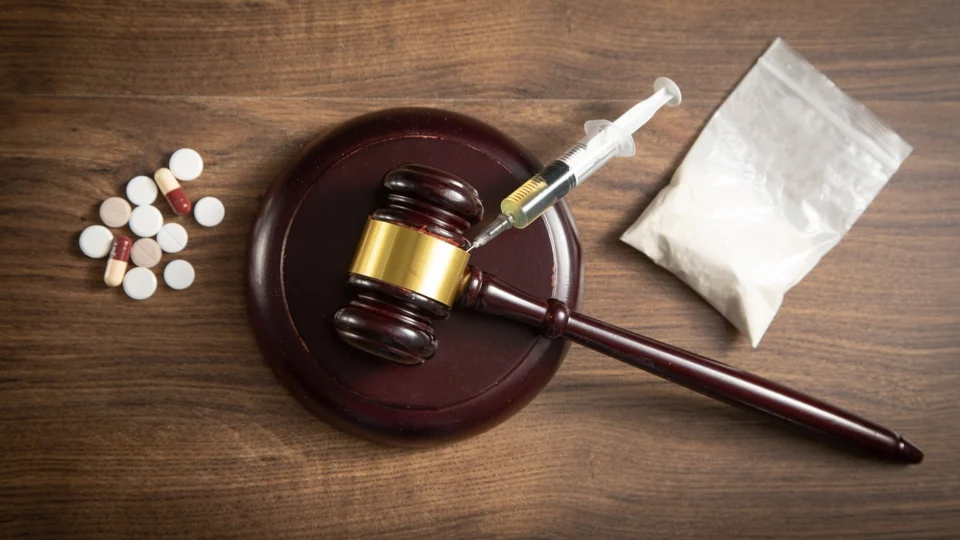
What turns a possession charge into a felony?
Simple possession is a misdemeanor for most people; it becomes a felony only with listed prior convictions, two prior drug convictions involving a hard drug, or a loaded gun.
Possession of a controlled substance under Health and Safety Code 11350 or 11377 carries up to 364 days in county jail. Each statute says "one year," and Penal Code 18.5 caps that at 364 days. The two sections then split on one word:
shall be punished by imprisonment in a county jail for not more than one year, except that such person shall instead be punished pursuant to subdivision (h) of Section 1170 of the Penal Code if that person has one or more prior convictions for an offense specified in clause (iv) of subparagraph (C) of paragraph (2) of subdivision (e) of Section 667 of the Penal Code or for an offense requiring registration pursuant to subdivision (c) of Section 290 of the Penal Code.
That is Health and Safety Code 11350(a), and its "shall" makes the felony term mandatory for a person with a qualifying prior. Section 11377(a) says "may," so the judge chooses. The qualifying priors are a short list in Penal Code 667(e)(2)(C)(iv), such as any homicide or attempted homicide and serious or violent felonies punishable by life, plus offenses requiring sex offender registration. A felony term is 16 months, 2 or 3 years.
Related charges often ride along with possession:
- Under the influence of a controlled substance (Health and Safety Code 11550): a misdemeanor with no minimum jail on a first or second conviction; a 180-day minimum applies only after two prior convictions within seven years and a refused rehabilitation program.
- Possession of drug paraphernalia (11364): the general penalty in 11374 is a $30 to $500 fine, 15 to 180 days, or both, and syringes held only for personal use are excluded.
- Maintaining a place for drug sales or use (11366): punishable by county jail up to 364 days or by state prison.
- Hard drug possession with two or more prior drug convictions: the 2024 treatment-mandated felony, explained next.
Who can be charged with the 2024 treatment-mandated felony?
Someone with two or more prior drug convictions who possesses a hard drug, such as fentanyl or methamphetamine, can be charged under Health and Safety Code 11395, a 2024 law.
Voters added the section through Proposition 36 of 2024, effective December 18, 2024; it is a different law from Proposition 36 of 2000. Under Health and Safety Code 11395, the prior convictions can be felonies or misdemeanors under the listed drug sections, including convictions entered before the law took effect. They must be alleged in the charging papers and then admitted or found true. Cannabis, LSD, psilocybin, mescaline and peyote are not hard drugs under the section.
The law puts treatment first. To choose treatment, a defendant pleads guilty or no contest, admits the priors, waives time for sentencing and agrees to finish a court-approved program built by a drug addiction professional. A completed program ends in dismissal, which the law says counts as no conviction for any purpose. The court can impose jail or prison only after finding the person ineligible or unsuitable for treatment, or when another circumstance the section lists applies. The firm's page on Proposition 36 treatment laws covers the details. UC Berkeley Law's Criminal Law and Justice Center published an April 2026 research brief on how counties have carried out court-mandated treatment under the measure.
What evidence turns personal possession into a sales case?
Prosecutors look for signs of intent to sell, such as packaging, scales, cash and messages; apart from cannabis, possession for sale, sale and transport for sale are felonies.
The main sales statutes and their base terms, usually served in county jail under Penal Code 1170(h), are:
- Drug possession for sale: 2, 3 or 4 years for narcotics such as heroin, cocaine or fentanyl (11351); 16 months, 2 or 3 years for methamphetamine (11378).
- Sale of a controlled substance: 3, 4 or 5 years for narcotics (11352); 2, 3 or 4 years for methamphetamine (11379).
- Transportation of a controlled substance: the same sections, but "transports" means "to transport for sale," so drugs carried for personal use are a possession case; moving drugs between noncontiguous counties raises the range to 3, 6 or 9 years.
- Manufacturing or producing controlled substances: 3, 5 or 7 years and a fine up to $50,000 (11379.6).
Cash or a scale alone is not the whole story; the firm's answer on whether cash proves intent to sell walks through how that evidence is tested. Larger cases can grow into drug trafficking charges. A conviction for selling a hard drug also brings a written warning under Health and Safety Code 11369 that if the conduct leads to a death, the person could be charged with homicide, up to murder.
When federal agents bring the case
A federal drug charge is a separate prosecution by the United States in federal court, under federal statutes and sentencing rules, even when the arrest happened in Beverly Hills. If a federal agency is involved, tell your criminal defense lawyer right away, because federal court runs on its own rules.
How do guns, weight and minors raise the stakes in a drug case?
A firearm, a large quantity or the involvement of a minor can add years, move the sentence to state prison and bring money bail back before arraignment.
- Armed during a sale offense. Being personally armed with a firearm during a listed sale or possession-for-sale offense adds 3, 4 or 5 consecutive years in state prison (Penal Code 12022(c)). See drug crimes with firearm enhancements.
- Possession while armed. Unlawfully possessing listed drugs, now including fentanyl, while armed with a loaded, operable firearm is its own felony with 2, 3 or 4 years in state prison, and PC 1000 diversion is not available (Health and Safety Code 11370.1).
- Weight. Health and Safety Code 11370.4 adds years for large quantities in sale cases, starting above 28.35 grams for fentanyl and above 1 kilogram for heroin or cocaine, served in state prison. See fentanyl-specific enhancements.
- Minors and protected places. An adult who uses a minor or furnishes narcotics to a minor faces 3, 6 or 9 years in state prison (11353); the same range applies to methamphetamine and similar drugs (11380). Other controlled substances fall under 11353.5: giving or selling one to a minor on the grounds of a school, public playground, day care, church or synagogue means 5, 7 or 9 years under Penal Code 1170(h). That section reaches only conduct during the site's hours for minors or while minors are using it, and only a seller at least five years older than the minor. See drug-free school zone violations.
- Out on another felony. A new felony committed while released on a pending felony adds 2 years if pleaded and proved, but the added term stands only if the earlier felony also ends in a conviction (Penal Code 12022.1).
Each enhancement must be charged and proved, and some can be struck in the interest of justice. That makes the charging papers worth a close read before any plea talk.
How much cannabis may an adult carry, and what is still a crime?
Adults 21 and older may possess up to 28.5 grams of cannabis and grow six plants at home; larger amounts, sales and possession by younger people can still be charged.
Adult use became lawful after voters approved Proposition 64 in 2016; the rules now sit in Health and Safety Code 11362.1. Marijuana (cannabis) accusations in Beverly Hills now turn mostly on age, amount and conduct:
- Ages 18 to 20 with 28.5 grams or less: an infraction with a fine up to $100.
- Age 18 or older with more than 28.5 grams: a misdemeanor, up to 6 months in county jail, a fine up to $500, or both.
- Growing more than six plants: usually a misdemeanor; cultivation of marijuana becomes a felony only in listed situations, such as certain priors.
- Carrying an opened cannabis package or loose flower while driving, unless it is in the trunk: an infraction with a fine of up to $100 (Vehicle Code 23222(b)).
State law and federal law do not match for most marijuana. The federal schedule in 21 CFR 1308.11(d) lists marihuana in Schedule I by default, according to the eCFR text current as of November 9, 2026, but a narrow exception moved to Schedule III on April 28, 2026: marijuana in a Food and Drug Administration approved product, or subject to a state medical marijuana license, is Schedule III under 21 CFR 1308.13(g)(2). A federal marijuana charge outside that narrow exception follows Schedule I, not California's adult-use rules.
How is a drug DUI from a Beverly Hills traffic stop handled?
Driving under the influence of a drug is a DUI under Vehicle Code 23152(f), with no fixed drug level; the question is whether the drug impaired your driving.
A valid prescription is no defense to a drug DUI (Vehicle Code 23630). The DMV's driver handbook section on alcohol and drugs puts it plainly: the law does not see a difference between illegal drugs and medications from a doctor or pharmacy. Cases about driving while high on marijuana follow the same impairment test.
A drug DUI runs on two tracks, like any DUI. The court case can bring jail, fines and a DUI program. On the license side, DMV's drug-only offense flyer says drug-only offenders are not subject to the administrative suspension DMV takes on arrest under its Administrative Per Se laws, though a conviction still brings a suspension or revocation. Refusing a chemical test is a separate matter: under Vehicle Code 13353 it brings its own suspension or revocation. The firm's Los Angeles County DUI defense page and its page on DMV hearing defense cover both sides, and its Beverly Hills DUI lawyer page covers local DUI details.
Which search and lab questions decide many drug cases?
The defense checks whether the stop and search were lawful, who actually controlled the drug, what the lab confirmed, and whether a prescription or another exception applies.
- The search. Under Penal Code 1538.5, the defense can move to suppress evidence taken in an unreasonable warrantless search or under a defective warrant. The firm's guide to illegal search and seizure shows how these motions work in drug cases.
- The lab. A field test is not the final word; the charge rests on what the substance is and how much there was. The firm's answer on independent testing of a seized drug sample explains how the defense can retest it.
- Control and knowledge. In a shared car, bag or home, reports, body camera video and photos show where the drug was and who was near it.
- Exculpatory evidence. The prosecution must disclose it (Penal Code 1054.1(e)), along with the defendant's statements and relevant real evidence.
A weak case can be attacked with a motion to dismiss charges, and connecting with a lawyer early leaves more time for pretrial negotiations. A negotiated plea must be approved by the judge, and that approval is not binding; if the judge withdraws it, the defendant may withdraw the plea (Penal Code 1192.5(c)).
Which diversion paths can close a Beverly Hills drug case without a conviction?
Pretrial drug diversion under Penal Code 1000 is the main route for eligible possession cases, with misdemeanor, mental health and Proposition 36 of 2000 options for others.
PC 1000 pretrial diversion covers listed personal-use charges, including 11350, 11364, 11365, 11375(b)(2), 11377 and 11550. Under Penal Code 1000, the defendant must have no drug conviction other than the listed offenses and no felony conviction in the five years before the offense, the charge must not involve violence or threatened violence, and there must be no evidence of a contemporaneous drug violation other than the listed offenses. Since 2018 the defendant pleads not guilty and waives the rights to a speedy trial, a speedy preliminary hearing and, where one applies, a jury trial under Section 1000.1; taking part is not a conviction or an admission of guilt. The program lasts 12 to 18 months, and then the charges are dismissed. Under Section 1000.4, the arrest is deemed never to have occurred and the court may seal it, with exceptions for peace officer applications and criminal justice agencies.
Other routes:
- Misdemeanor diversion. A judge may divert most misdemeanors for up to 24 months over the prosecutor's objection, though not domestic violence, stalking or offenses requiring sex offender registration (Penal Code 1001.95), and appellate courts have held it does not reach DUI.
- Mental health diversion. Penal Code 1001.36 can reach misdemeanors and felonies when a mental disorder diagnosed within the last five years was a significant factor, a qualified mental health professional says the symptoms would respond to treatment, the person consents, waives a speedy trial and agrees to treatment, and the judge finds no unreasonable risk of danger to public safety.
- Proposition 36 of 2000. Penal Code 1210.1 requires probation with drug treatment, and no added jail, for a nonviolent drug possession offense, subject to listed exclusions.
The firm's page on diversion compares the programs. For collaborative treatment courts, Judicial Council guidelines say candidates should be identified early and those who fit certain criteria for eligibility placed promptly. Even a dismissed case can carry collateral consequences for licenses and background checks, so ask what the order will say.
Where are Los Angeles County's treatment courts, and who can enter one?
The county's Community Collaborative Courts take felony cases at four courthouses, Central, Van Nuys, Compton and Long Beach, and separate courts serve co-occurring disorders and sentenced drug cases.
Each option is described on the Public Defender's treatment courts page. Community Collaborative Courts accept people charged with felonies or facing felony probation violations, including people with a substance use disorder; the Probation Department screens each referral, and an accepted participant serves three to five years of probation under a treatment plan. Completion may earn a dismissal under Penal Code 1203.4. Two narrower courts sit beside it: the Co-Occurring Disorders Court, for people charged with felonies who have both a mental illness and a substance use disorder, and the Sentenced Offender Drug Court, which offers treatment after conviction instead of prison.
The Judicial Council's Standard 4.10 describes adult collaborative treatment courts, including adult drug courts, as postadjudication courts that offer an alternative to ordinary case processing. The firm's answer on Los Angeles County collaborative courts covers how a referral is made from a courthouse such as the Airport Courthouse.
How can a drug plea affect a green card or visa?
Drug convictions can carry serious immigration consequences, so California requires a verbatim warning before a plea and accurate immigration advice from defense counsel.
Before accepting a guilty or no contest plea to any crime other than an infraction, the judge must read this advisement word for word under Penal Code 1016.5:
If you are not a citizen of the United States, you are hereby advised that conviction of the offense for which you have been charged may have the consequences of deportation, exclusion from admission to the United States, or denial of naturalization pursuant to the laws of the United States.
Defense lawyers must give accurate and affirmative advice about the immigration consequences of a proposed disposition (Penal Code 1016.3), and prosecutors must consider avoiding them as one factor in negotiations. If you are not a citizen, get immigration advice before you accept any offer, including a diversion agreement. See the firm's Beverly Hills immigration lawyer page for status questions.
How much does a drug defense cost, and can you pay over time?
The fee depends on the charge, any enhancements, and whether the case resolves early or needs motions and trial; the firm offers a free consultation and payment plans.
A first possession case headed for diversion usually needs less work than a sales case with a suppression motion and a lab dispute. Before signing, find out what the fee includes and how payments would be spread out. Court costs, program fees and any fines are separate from legal fees.
For a meeting in person, the firm's office in Beverly Hills is listed at 433 North Camden Dr, Suite 600, Beverly Hills, CA 90210; call (310) 882-6277.
Drug charge questions from Beverly Hills
Will a drug charge show up on a background check even if the case is dismissed?
It can. An arrest record exists even when the case is dismissed. After successful PC 1000 diversion, the arrest is deemed never to have occurred and may be sealed, but peace officer applications and criminal justice agencies are exceptions (Penal Code 1000.4). A person may also petition to seal an arrest that did not end in a conviction (Penal Code 851.91).
If the police catch me with drugs in my possession, do I have to answer their questions?
No. You may decline to answer questions about the drugs and say you want a lawyer. Follow lawful orders and do not resist. If you are cited, signing the written promise to appear gets you released (Penal Code 853.6(d)). Anything you say about whose drugs they are can become evidence.
Can I expunge a previous drug conviction in Beverly Hills, CA?
You may be able to. After probation, Penal Code 1203.4 lets the court dismiss most convictions if no sentence, probation or charge is pending, though the conviction can still count in a later case and gun rights are not restored. A felony possession conviction that would have been a misdemeanor under Proposition 47 can be redesignated under Penal Code 1170.18. For the forms, the District Attorney's FAQ points to your former lawyer or the convicting court's clerk.
What's the difference between PC 1000 and Proposition 36 diversion?
PC 1000 is pretrial diversion: you plead not guilty, waive speedy trial rights and a jury trial, finish a program in 12 to 18 months, and the charge is dismissed. Proposition 36 of 2024 created the treatment-mandated felony, where treatment follows a guilty or no contest plea and admitted priors. Proposition 36 of 2000 is a third law: probation with treatment after a nonviolent possession conviction.
Is a first-time drug possession charge a felony in Beverly Hills, CA?
Usually not. Simple possession under Health and Safety Code 11350 or 11377 is a misdemeanor unless you have a listed prior conviction. A felony can also follow from possession with intent to sell, a loaded firearm, or two prior drug convictions with a hard drug. The charging papers show which statute applies.
Can I keep taking methadone if I am held at the Beverly Hills jail?
Possibly. The department's jail manual lets a person in a methadone maintenance program continue it at the program director's discretion once the jail verifies participation. Someone who needs treatment in custody is transported to the appropriate county facility. Tell the jailer about the program right away.
Speak with a drug charges lawyer about a Beverly Hills arrest
A Beverly Hills drug arrest moves quickly from the jail on Rexford Drive to the Airport Courthouse, and early advice can shape diversion, release and the first offer.
Call (800) 755-5174 or ask about a free case review online. The Law Offices of David S. Chesley gives a free consultation, answers calls 24/7, offers payment plans, and se habla español. For a charge outside drug law, see the firm's Beverly Hills criminal defense lawyer page.
































