



A drug charges lawyer in Orange defends cases that run from simple possession, usually a misdemeanor, to possession for sale, transport for sale and manufacturing, which are felonies. A first possession case can qualify for pretrial diversion that ends in dismissal. Misdemeanor cases from the City of Orange are heard at the Central Justice Center in Santa Ana.
Our law firm has been featured on






David Chesley in the news
Select a photo to enlarge







Where does a drug case from the City of Orange go to court?
The Central Justice Center in Santa Ana hears criminal cases from Orange, although a felony trial can be sent to any open courtroom in the county.
The Orange County Superior Court lists its "Cities Served" on each courthouse page. For the Central Justice Center, 700 Civic Center Drive West, Santa Ana, CA 92701, the list names Orange, Santa Ana, Tustin and Villa Park. The building's criminal and traffic line is (657) 622-8459. The court's Court Designation List, effective June 30, 2025, adds one limit: "Felony trials will be assigned based on availability of open trial courtrooms at any of the justice centers." Your citation or release paper names the court and the first date. The firm's guide to which Orange County courthouse hears a criminal case covers the other three justice centers.
A misdemeanor drug case can sometimes start without you standing in court. The court's informal arraignment page explains that under Local Rule 856, "the informal arraignment process is only available to attorneys for misdemeanor offenses." A lawyer may enter a not guilty plea and "set a pretrial and jury trial date with the clerk by phone, fax, or in person," subject to the rule's exceptions. That can keep a working parent or student out of the courtroom on the first date. Felony cases do not use this process.
The prosecutor decides what to file. The Orange County District Attorney keeps a branch office in the Central Justice Center building, at the same address. If you cannot afford a lawyer, the Orange County Public Defender's main office is at 801 Civic Center Drive West, Suite 400, Santa Ana, CA 92701, phone (657) 251-6090.
What happens between an Orange drug arrest and release?
An Orange drug arrestee is booked at a city or county jail, then cited out, bailed out or brought before a judge within 48 hours, not counting Sundays and holidays.
The court's own court appearance page says an arrested person "will be detained at one of the city or county jail facilities." People booked into the county system go through the Sheriff's Intake Release Center, which, in the Sheriff's words, "is responsible for processing all individuals being booked into, and released from, the Orange County Jail system." One of the county jails, the Theo Lacy Facility, sits inside the City of Orange.
- Calls. At least three completed phone calls right after booking, and within three hours of arrest unless physically impossible, one of them unmonitored to a lawyer (Penal Code 851.5).
- Finding someone. The Sheriff's Inmate Information System requires an account and "does not provide the ability to view inmate charges." Inmate Records answers at (714) 647-4666.
- Timing. The Sheriff's jail FAQ says "Bail information is usually available after 2-3 hours" and that release after bail averages about four hours, from two to six.
- Court within 48 hours. Someone not released must see a judge "within 48 hours after his or her arrest, excluding Sundays and holidays" (Penal Code 825(a)(1)). It limits how long someone can wait to see a judge, but release is a separate decision.
A misdemeanor possession arrest can end with a written notice to appear instead of a night in custody, because Penal Code 853.6 requires release on a citation for most misdemeanors unless a listed reason applies. Keep that paper. It carries the court date.
How much is bail on an Orange County drug charge?
Orange County's 2026 bail schedule lists $2,500 for misdemeanor possession and $20,000 to $30,000 for common felony drug charges, before any weight increases.
The Superior Court's 2026 Uniform Bail Schedule is "effective January 1, 2026." Its purpose is to set the amount for release "prior to appearance in court"; once a judge sees the case, the amount "may be greater or less than the amount set forth in this schedule." Pre-Trial Services answers bail questions 24 hours a day at (714) 647-4581.
| Charge | Section | Scheduled bail |
|---|---|---|
| Misdemeanor possession, first time | HSC 11350 or 11377 | $2,500 |
| Misdemeanor possession, second or later | HSC 11350 or 11377 | $10,000 |
| Possession with two or more prior drug convictions | HSC 11395 | $2,500, posted only with a magistrate's approval |
| Under the influence of a controlled substance (the schedule's "Narcotic addict" line) | HSC 11550 | $1,000; $2,500 on a second |
| Felony possession | HSC 11350 or 11377 | $20,000 |
| Possession or purchase for sale | HSC 11351 or 11378 | $25,000, rising with weight |
| Sale, transport or furnishing of narcotics; cocaine base for sale | HSC 11352; 11351.5 | $30,000, rising with weight |
| Manufacturing | HSC 11379.6(a) | $75,000 |
Two rules shape what happens next. For the Proposition 36 charge, Health and Safety Code 11395(f) requires "judicial review prior to release," which is why the schedule says those cases need a magistrate's approval. And a misdemeanor defendant in custody at arraignment "shall be entitled to an own recognizance release" unless the court finds on the record that an own recognizance release will compromise public safety or will not reasonably assure the defendant's appearance (Penal Code 1270(a)).
When a judge does set money bail, two California Supreme Court decisions control. In re Humphrey (2021) held that "the court must consider the arrestee’s ability to pay the stated amount of bail" and should consider "whether nonfinancial conditions of release may reasonably protect the public and the victim or reasonably assure the arrestee’s presence at trial." In re Kowalczyk (April 30, 2026) added that bail "must generally be set in an amount that is reasonably attainable," though it "need not be easily affordable or convenient." The burden falls on the defendant: a person who claims inability to pay must "support that allegation with reliable evidence." See the firm's answer on how California bail amounts are set.
How does California classify the drug in your case?
California law groups drugs into schedules, and the schedule decides which possession or sale statute applies, so the lab report naming the substance matters.
The table below links the firm's page on each drug. A "controlled substance" is a drug listed in one of the schedules in Health and Safety Code 11054 to 11058. Brand names do not appear in the statutes, so a pill is classified by its generic ingredient.
| Drug | Where California lists it | Possession statute |
|---|---|---|
| Prescription drugs | Alprazolam (sold as Xanax) is on the 11375(c) list; amphetamine (in Adderall) is HSC 11055(d)(1) | 11375 for alprazolam (infraction or misdemeanor); 11377 for amphetamine |
| Ecstasy | Depends on the chemical the lab finds; the related compound MDA is listed at HSC 11054(d)(6) | 11377 for a listed 11054(d) hallucinogen |
| Cocaine | HSC 11055(b)(6); cocaine base is 11054(f)(1) | 11350 |
| Methamphetamine | HSC 11055(d)(2) | 11377 |
| Opioids | Oxycodone and morphine, HSC 11055(b)(1)(M) and (L) | 11350 |
| Heroin | HSC 11054(c)(11) | 11350 |
| Fentanyl | HSC 11055(c)(8) | 11350 |
The schedules are in Health and Safety Code 11055 and the neighboring sections. Benzodiazepines such as alprazolam, diazepam, clonazepam and lorazepam follow their own rule: Health and Safety Code 11375 applies to them "and not Sections 11377, 11378, 11379, and 11380," and possession is "an infraction or a misdemeanor."
Fentanyl draws the hardest response because of its strength. The federal DEA fentanyl fact sheet says it is "approximately 100 times more potent than morphine and 50 times more potent than heroin as an analgesic." If a case involves addiction, SAMHSA's National Helpline, 1-800-662-HELP (4357), is a free, confidential treatment referral line that answers 24 hours a day. Early treatment can also matter for the diversion and treatment options described below.
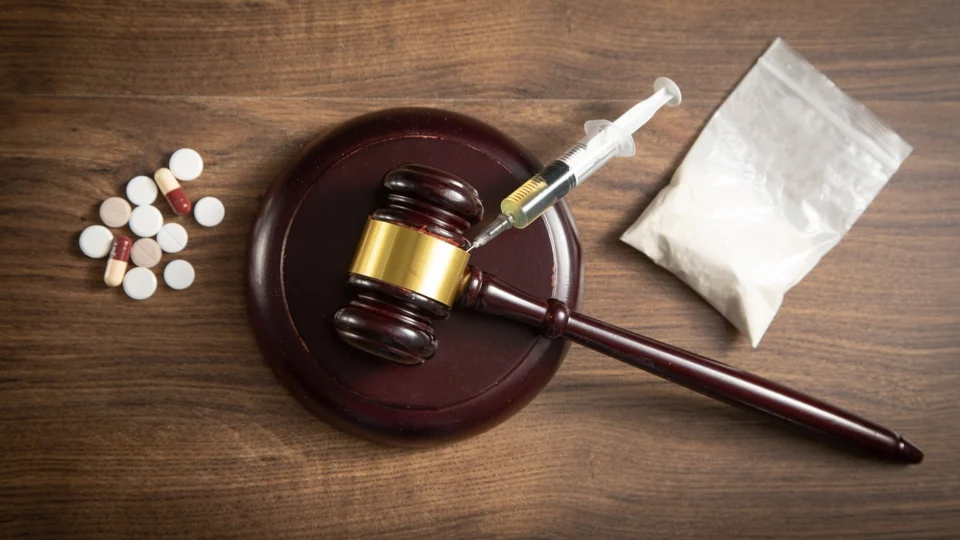
Which possession charges stay misdemeanors in Orange, and which can become felonies?
Possessing heroin, cocaine, fentanyl or methamphetamine is a misdemeanor, up to 364 days, unless Penal Code 667(e)(2)(C)(iv) or sex-registration priors, two drug priors or a loaded gun change the charge.
Two statutes cover most possession cases. Health and Safety Code 11350 covers heroin, cocaine, cocaine base, fentanyl and other narcotics. Health and Safety Code 11377 covers methamphetamine, amphetamine, PCP, LSD, psilocybin, ketamine and other non-narcotic drugs. Both say "imprisonment in a county jail" for "not more than one year," and Penal Code 18.5 turns that into a maximum of 364 days.
The two sections differ by a single word when a person has a listed prior. Section 11350 says the person "shall instead be punished" under Penal Code 1170(h), the felony route. Section 11377 says the person "may instead be punished" that way, which leaves the choice to the court. The prior must be an offense on the short list in Penal Code 667(e)(2)(C)(iv), such as a homicide offense or a sexually violent offense, or an offense that requires sex offender registration under Penal Code 290(c). An ordinary earlier felony is not enough.
| Situation | Class | Statute |
|---|---|---|
| Heroin, cocaine, fentanyl or another narcotic, no listed prior | Misdemeanor, up to 364 days | 11350(a) |
| Methamphetamine or another 11377 drug, no listed prior | Misdemeanor, up to 364 days | 11377(a) |
| Either drug with a 667(e)(2)(C)(iv) or 290(c) prior | Felony under 1170(h): required for 11350, optional for 11377 | 11350(a), 11377(a) |
| A hard drug with two or more prior drug convictions | Treatment-mandated felony or misdemeanor | 11395 |
| Listed drugs while armed with a loaded, operable firearm | Felony, 2, 3 or 4 years in state prison | 11370.1(a) |
The firm's Orange drug crimes page walks through the charges and defenses in more detail. For the possession charges themselves, see possession of a controlled substance, hard drug possession, possession of drug paraphernalia and being under the influence of a controlled substance.
What is still illegal about cannabis in Orange?
Adults 21 and older may possess up to 28.5 grams of cannabis and grow six plants at home, but sales, larger amounts, use while driving and by minors remain offenses.
Cannabis contains THC, its principal psychoactive compound. The adult rules are in Health and Safety Code 11362.1, the section voters added in 2016. A person 21 or older may possess "not more than 28.5 grams of cannabis not in the form of concentrated cannabis," up to eight grams of concentrate, and "not more than six living cannabis plants." Plants must be kept in a locked space at the home, out of public view. Lawful cannabis is "not contraband," and lawful conduct cannot be "the basis for detention, search, or arrest."
| Who | Amount | Result |
|---|---|---|
| 21 and over | Up to 28.5 grams, 8 grams of concentrate | Lawful |
| 18 to 20 | Up to 28.5 grams | Infraction, fine up to $100 |
| Under 18 | Up to 28.5 grams | Infraction with drug education and community service |
| 18 and over | More than 28.5 grams | Misdemeanor, up to 6 months and $500 |
Selling cannabis, possessing it for sale or growing more than six plants is a misdemeanor for adults, with felony exceptions for listed prior convictions, repeat convictions, sales to minors, environmental violations in growing, and importing or exporting more than 28.5 grams (Health and Safety Code 11358 to 11360). Having an opened container of cannabis or loose cannabis flower on your person while driving is an infraction with a fine up to $100 (Vehicle Code 23222(b)). The firm's pages on marijuana (cannabis) allegations in Orange and statewide and cultivation of marijuana cover the rest.
What turns a possession arrest into a sale or transport charge?
When the prosecution claims intent to sell, a possession arrest can become a felony possession-for-sale charge carrying 16 months to 4 years or more.
Possession for sale is a separate felony. Health and Safety Code 11351 (heroin, cocaine, fentanyl and other narcotics) carries two, three or four years under Penal Code 1170(h), usually served in county jail, and Health and Safety Code 11372 allows a fine up to $20,000. Health and Safety Code 11378 (methamphetamine and other 11377 drugs) states no term of its own, so Penal Code 1170(h)(1) supplies 16 months, two or three years, and Penal Code 672 allows a felony fine up to $10,000.
| Charge | Section | Term |
|---|---|---|
| Possession for sale of narcotics | HSC 11351 | 2, 3 or 4 years |
| Possession for sale of methamphetamine | HSC 11378 | 16 months, 2 or 3 years |
| Selling or transporting narcotics for sale | HSC 11352 | 3, 4 or 5 years; 3, 6 or 9 years across noncontiguous counties |
| Selling or transporting methamphetamine for sale | HSC 11379 | 2, 3 or 4 years; 3, 6 or 9 years across noncontiguous counties |
| Manufacturing | HSC 11379.6 | 3, 5 or 7 years and a fine up to $50,000 |
One word in these statutes protects people who only carried drugs for themselves. In Health and Safety Code 11352(c) and 11379(c), "“transports” means to transport for sale." Driving across Orange with drugs for personal use is a possession case, not a transport felony. The answer on whether cash proves intent to sell covers one common sale theory.
The firm handles each of these charges: drug possession for sale, sale of a controlled substance, transportation of a controlled substance, drug trafficking, manufacturing or producing controlled substances and maintaining a place for drug sales or use.
Which enhancements add time to an Orange County drug sentence?
A firearm, a large weight, a sale near minors or a new felony while on bail can add years, and some move the sentence from county jail to state prison.
- Personally armed during a sale offense: an added three, four or five years in state prison (Penal Code 12022(c)).
- Weight: for fentanyl, an added three years above 28.35 grams, rising in steps to 25 years above 80 kilograms; heroin, cocaine and methamphetamine steps start above one kilogram (Health and Safety Code 11370.4). A weight enhancement means state prison.
- A new felony while out on bail or own recognizance for another felony: two added years (Penal Code 12022.1(b)).
- Injury to the user: since Proposition 36 of 2024, a seller is treated as personally inflicting great bodily injury when the person who used the drug suffers significant or substantial physical injury from it (Penal Code 12022.7(f)(2)).
- Minors and schools: an adult who sells or furnishes heroin, cocaine, fentanyl, methamphetamine or many other drugs to a minor faces three, six or nine years in state prison (Health and Safety Code 11353, 11380). For a controlled substance outside those two sections, an adult at least five years older than the minor who sells or gives it to the minor at a school, playground, day care, church or synagogue, while it is open for classes, programs or child care or while minors are using it, faces five, seven or nine years (11353.5).
Enhancements must be charged and proved, and some can be struck in the interest of justice. See the firm's pages on drug charges with firearm enhancements, fentanyl-specific enhancements and drug-free school zone violations.
Some cases leave the state system. A federal drug charge can come from the same kind of conduct when federal prosecutors bring the case, and federal sentencing rules then apply. A federal case needs a criminal defense lawyer prepared for federal court, which runs on different rules from the Santa Ana courts.
What changed in Orange County under Proposition 36 of 2024?
Since December 18, 2024, a third drug case involving a hard drug can be charged as a treatment-mandated felony, and certain fentanyl cases carry new penalties.
The new charge is Health and Safety Code 11395. It applies to a person with "two or more prior convictions" for listed drug offenses, including convictions from before the law took effect, who now possesses a "hard drug." The priors "shall be alleged in the accusatory pleading, and either admitted by the defendant in open court or found to be true." Hard drugs include fentanyl, heroin, cocaine, cocaine base, methamphetamine and PCP; cannabis, LSD, psilocybin, mescaline and peyote are excluded.
Treatment is the center of it. The person may elect treatment by pleading guilty or no contest, admitting the priors and agreeing to a detailed program approved by the court. A person "shall not be sentenced to jail or prison" under this section unless the court finds them not eligible or suitable for treatment, or another listed circumstance applies. Finishing treatment leads to dismissal, and that dismissal "shall not count as a conviction for any purpose." The law also added a written warning on hard-drug sale convictions (Health and Safety Code 11369) and fentanyl weight steps. This is different from Proposition 36 of 2000, the older treatment-probation law described below.
The firm's page on Proposition 36 treatment laws covers the history in more depth.
How does Penal Code 1000 diversion work in Orange County?
Penal Code 1000 lets a person charged with simple possession plead not guilty, finish a program in 12 to 18 months, and have the charge dismissed.
Penal Code 1000 lists the charges it covers, including 11350, 11357, 11364, 11365, 11375(b)(2), 11377 and 11550. It has four conditions: no drug conviction in the five years before the charged offense other than for the listed offenses, no violence or threat of violence, no other contemporaneous drug violation, and "no prior felony conviction within five years." Under Section 1000.1, the person "pleads not guilty to the charge or charges" and waives speedy trial and jury rights. Participation "shall not constitute a conviction or an admission of guilt for any purpose."
- The prosecutor reviews eligibility, and the court decides whether to grant diversion.
- The court sets a program, education or treatment, for 12 to 18 months, with extensions for good cause.
- On completion, "the criminal charge or charges shall be dismissed."
- Under Section 1000.4, the arrest "shall be deemed to have never occurred," with exceptions such as peace officer job applications.
Orange County runs the programs through its Health Care Agency. The agency's DUI Education and Court Diversion unit "oversees the DUI, PC1000 and PC1210 programs in Orange County." It keeps Alcohol Liaison Offices at the Central, Harbor, North and West courts, where "A list of PC1000 and PC1210 providers are also available," although "referrals for these programs are not issued or coordinated by the ALO program." The Central Justice Center's page lists the Alcohol Liaison at (714) 834-3007.
Diversion often runs alongside early negotiations with the prosecutor, so acting fast matters. For a misdemeanor outside the PC 1000 list, a judge may offer diversion even over the prosecutor's objection (Penal Code 1001.95), except for domestic violence, stalking or an offense requiring sex offender registration; published appellate decisions also hold it unavailable for a DUI, including a drug DUI. See the firm's pages on PC 1000 pretrial diversion and other drug diversion programs, and its overview of collateral consequences that diversion can avoid.
Who is Orange County's Adult Drug Court for?
Adult Drug Court is a voluntary, court-supervised treatment program for people with serious addiction, lasting at least 18 months in five phases.
The Superior Court's collaborative courts page describes the program as a partnership of the court, Probation, the Health Care Agency, the Public Defender, the District Attorney and the Sheriff that "provides an alternative to incarceration for defendants who meet the program's eligibility criteria." It "works with seriously addicted criminal offenders who are at high risk of recidivation." Participants face intensive probation supervision, counseling, random testing and frequent court dates. To graduate, a participant must be working or in school, attend self-help meetings and keep up with every appointment.
These courts follow statewide guidelines. California's Standards of Judicial Administration, standard 4.10, describes adult collaborative treatment courts as "evidence-based, postadjudication courts that provide an alternative to traditional criminal justice case processing." Postadjudication means the program follows a plea or finding, unlike Penal Code 1000. The firm's answer on Orange County's collaborative courts covers DUI Court and the other programs.
Proposition 36 of 2000 still exists too. Under Penal Code 1210.1, a person convicted of a "nonviolent drug possession offense" receives probation with a required treatment program, and the court "may not impose incarceration as an additional condition of probation," subject to exclusions.
What if the Orange arrest also involved driving on drugs?
Driving under the influence of any drug is a separate DUI charge, and no number is needed to prove it; the question is whether the drug impaired the driver.
Drug DUI is Vehicle Code 23152(f): "It is unlawful for a person who is under the influence of any drug to drive a vehicle." A valid prescription is not a defense under Vehicle Code 23630. The DMV's handbook on alcohol and drugs covers how impairment affects driving. See the firm's pages on drug DUI defense and driving while high on marijuana.
The license side works differently from an alcohol case. The DMV's drug-only offender flyer says drug-only offenders "are not subject to an administrative license suspension taken by the Department of Motor Vehicles (DMV) upon arrest." A refusal to take the chemical test, or an alcohol result of 0.08% or more, does bring a suspension notice. If you received one, Vehicle Code 13558(b) gives 10 days from receiving it, usually at the arrest, to request a hearing before the suspension starts. The DMV may accept a late request but does not have to. An Orange County DUI defense lawyer can handle the court case and the DMV hearing together. The firm's Orange DUI page covers the local DUI process.
What can undercut the evidence in an Orange possession case?
How the search was done, any prescription, the paraphernalia exceptions and what the evidence file shows can each defeat or narrow a possession charge.
- The search. A motion under Penal Code 1538.5 asks the court to exclude evidence when "The search or seizure without a warrant was unreasonable." See illegal search and seizure in drug cases.
- The prescription. Section 11350 excepts a drug held "upon the written prescription" of a licensed physician, dentist, podiatrist or veterinarian, and 11377 has a similar prescription exception. Holding a drug for the person who has the prescription, with their authorization, is also covered when the sole intent is to deliver it or discard it lawfully.
- Paraphernalia. The paraphernalia law in Health and Safety Code 11364 does not apply to syringes possessed "solely for personal use." Being where drugs are used is a crime only "where the defendant aids, assists, or abets" the use (11365(b)).
- The evidence file. The prosecution must turn over the defendant's statements, real evidence and "Any exculpatory evidence" (Penal Code 1054.1), usually at least 30 days before trial.
Not every case should go to trial. A plea agreement accepted by the prosecutor and approved by the court limits the sentence to what was agreed (Penal Code 1192.5(b)), and a judge who withdraws approval must let the defendant withdraw the plea. When the evidence is thin, a motion to dismiss charges may fit.
Can a drug conviction in Orange affect immigration status?
Yes: almost any drug conviction can make a noncitizen deportable, with one narrow exception for a single small marijuana possession offense.
Federal law at 8 U.S.C. 1227(a)(2)(B)(i) makes deportable a noncitizen convicted of a law "relating to a controlled substance," "other than a single offense involving possession for one’s own use of 30 grams or less of marijuana." Before any guilty or no contest plea to a misdemeanor or felony, the judge must read the immigration advisement in Penal Code 1016.5 word for word, and defense counsel must give "accurate and affirmative advice about the immigration consequences of a proposed disposition" (Penal Code 1016.3).
Talk to immigration counsel before accepting any plea or program, including diversion. The firm's Orange immigration lawyer page explains the immigration court and federal offices that serve Orange.
How can an Orange County drug case be cleared from your record later?
Completed diversion, a dismissal after probation, or a Proposition 47 reduction can each clear or shrink a drug record, though none deletes it for every purpose.
| Relief | Who it helps | Section |
|---|---|---|
| Arrest deemed never to have occurred | People who complete PC 1000 diversion | PEN 1000.4(a) |
| Dismissal after probation | Drug convictions that ended with probation | PEN 1203.4 |
| Felony redesignated as a misdemeanor | Old felony possession convictions that Proposition 47 made misdemeanors | PEN 1170.18(f) |
| Withdrawal of an old deferred entry of judgment plea | People who completed the pre-2018 version of PC 1000 | PEN 1203.43 |
Penal Code 1203.4 relief comes only after probation ends, when it was completed or ended early or the court finds relief in the interest of justice, and only for someone not then serving a sentence, on probation or charged with an offense. A dismissal under Penal Code 1203.4 still counts in a later prosecution, must still be disclosed on some license applications, and "does not permit a person to own, possess, or have custody or control of a firearm." The Proposition 47 route under Penal Code 1170.18 has no filing deadline in its current text. See the firm's page on expungement in California.
What should you do first, and what does an Orange drug defense cost?
Stay quiet about the drugs, keep every paper you were given, note the court date, and get a free consultation before the first appearance.
- Do not explain where the drugs came from or sign a written statement. Ask for a lawyer.
- Keep the citation, the property receipt and any release paper. They name the charge and the court date.
- Check the case through the court's online case access before the date, then confirm the courtroom.
- Write down who was in the car or home, and whose items were where.
- If there is a prescription, find the bottle or pharmacy record.
Cost depends on the charge, whether it is a misdemeanor or a felony, and whether diversion or a trial is the goal. The Law Offices of David S. Chesley offers a free consultation, is available 24/7, and has payment plans. Ask about fees and payment terms before you agree to representation. The firm's Orange office is at 500 North State College Blvd., Suite 1100, Orange, CA 92868, phone (714) 442-2601; see the Orange office page for directions.
More questions about drug charges in Orange
Will a drug charge show up on a background check even if the case is dismissed?
It can. An arrest record can exist even when no conviction follows. After completed PC 1000 diversion, the arrest is deemed never to have occurred and the court may seal it, but peace officer applications are an exception. Penal Code 851.91 lets a person petition to seal an arrest that did not end in a conviction.
If the police catch me with drugs in my possession, do I have to answer their questions?
No. Give your name and identification when the law requires it, then say you want a lawyer. You do not have to explain the drugs, where they came from or whose they are. Do not sign a written statement. Keep the citation and any search inventory so a lawyer can review how the evidence was found.
Can a drug conviction be expunged in Orange, CA?
Usually it can be dismissed under Penal Code 1203.4 after probation (completed, ended early, or in the court's discretion in the interest of justice), while you are not serving a sentence, on probation or facing a charge; drug offenses are not on its excluded list. The dismissal is not a full erasure: the conviction can still be used in a later case, must be disclosed for some licenses, and does not restore gun rights.
What's the difference between PC 1000 and Proposition 36 diversion?
PC 1000 is pretrial diversion with a not guilty plea and dismissal after 12 to 18 months. Proposition 36 of 2024 (Health and Safety Code 11395) is for a hard-drug case with two or more drug priors and uses a guilty or no contest plea before treatment. Proposition 36 of 2000 (Penal Code 1210.1) is treatment probation after a conviction.
If I don't have a record, will my drug possession charge be a felony in Orange, CA?
Simple possession without a listed prior is a misdemeanor under Health and Safety Code 11350 or 11377. A felony can still be filed for possession for sale, sale or transport, manufacturing, or possession while armed with a loaded, operable firearm. The complaint, not the arrest report, shows what was charged.
How long after an arrest in Orange can bail be posted?
The Sheriff says bail information is usually available 2 to 3 hours after booking, and release after posting averages about four hours. Inmate Records at (714) 647-4666 can confirm the amount. A Proposition 36 charge under Health and Safety Code 11395 needs a magistrate's approval before bail can be posted.
Talk to an Orange drug charges lawyer
If you or someone you love was arrested for a drug crime in Orange, call before the first court date. The Law Offices of David S. Chesley offers a free consultation, is available 24/7, and offers payment plans. Se habla español. Our local Orange drug charges lawyers are ready to review the search, the lab result and the diversion options. Call (800) 755-5174 or use our contact form.
See our Orange theft lawyer page if this case also involves a theft charge. The firm also handles criminal defense, violent crimes and sex crimes cases in Orange.
































